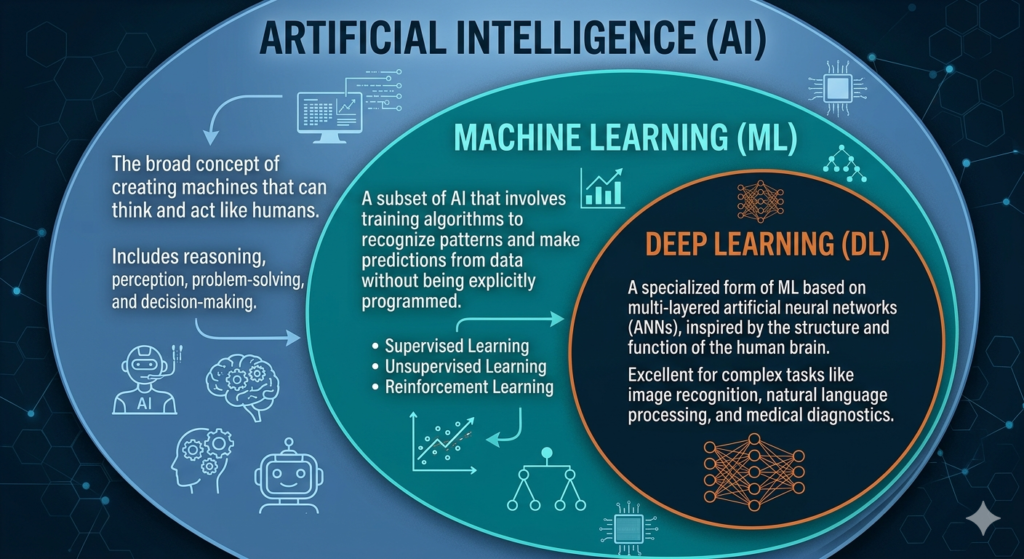
Artificial Intelligence (AI), Machine Learning (ML), and Deep Learning (DL) are often mentioned together, but they are not the same thing. Think of them like Russian nesting dolls: the biggest doll is AI, inside it is ML, and inside that is DL. In other words, all ML is AI, but not all AI is ML; all DL is ML (and thus AI). Understanding this hierarchy will help avoid confusion.
What is Artificial Intelligence (AI)?
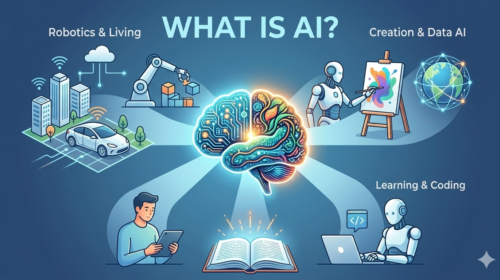
AI is the broadest term. It refers to any computer system that performs tasks in a way that seems “smart.” AI is an umbrella for any technique that enables computers to mimic human intelligence. This can include simple rule-based programs or very advanced systems. For example, if you write a program with a thousand if/else statements to play chess, that’s technically AI—because it mimics human-like decision-making, even though it doesn’t actually learn.
In textbooks, AI is defined as the science of creating machines that perform tasks requiring human intelligence. John McCarthy, who coined the term, described it as “the science and engineering of making intelligent machines.” Common AI tasks include recognizing images, understanding speech, or solving puzzles. But remember: not all AI systems learn from data; some just follow pre-set rules.
What is Machine Learning (ML)?
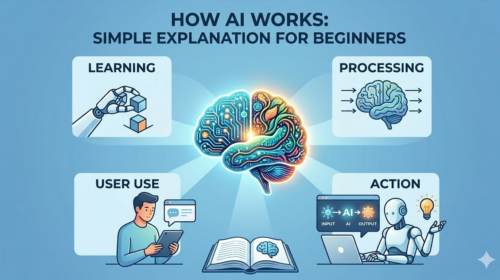
Machine Learning is a subset of AI focused on learning from data. Instead of hard-coding every rule, ML algorithms allow computers to find patterns and improve from experience. For example, if you show an ML algorithm 10,000 pictures of cats and dogs, it figures out the differences (ears, fur, shape) by itself. This is how many modern applications work: Netflix learns your viewing preferences, email learns to catch spam, and voice assistants learn to recognize your commands.
A classic definition of ML is: “Machine Learning is a field of study that gives computers the ability to learn without being explicitly programmed.” In practice, ML covers everything from simple linear regression and decision trees to complex algorithms. But at the core, ML is about using data and mathematical models so a system can improve its performance on a task over time. Importantly, all ML is AI, but not all AI is ML. For instance, rule-based expert systems (like a tax calculator using hard-coded logic) are AI but not ML.
What is Deep Learning (DL)?
Deep Learning is a specialized part of machine learning. It uses large neural networks with many layers (hence “deep”) to learn from vast amounts of complex data. Think of it like an ML algorithm on steroids: DL can automatically learn very complicated features without manual intervention. It requires powerful hardware (often GPUs) and lots of data. For example, deep learning enables self-driving cars to recognize pedestrians, virtual assistants to understand voice, and chatbots like GPT-4 to generate human-like text.
Because DL uses many layers of neurons, it excels at tasks like image and speech recognition that older algorithms struggle with. However, this power comes at a cost: deep learning needs far more data and computing power than traditional ML. Remember: all deep learning is machine learning, and all machine learning is AI.
How AI, ML, and DL Are Related
In summary:
- Artificial Intelligence (AI): The broad field of creating systems that behave intelligently.
- Machine Learning (ML): A subset of AI where computers learn from data instead of following fixed rules.
- Deep Learning (DL): A subset of ML that uses deep neural networks to learn from huge datasets.
You can remember it like this: DL ⊂ ML ⊂ AI. For example, a simple calculator program is AI (it performs a task), but it’s not ML because it doesn’t learn from data. A photo tagging app that learns from many example pictures is ML (and AI). An advanced voice assistant using a neural network is DL (and thus also ML and AI).
Here are some key differences:
- Learning vs. Rules: ML/DL systems learn from examples, while rule-based AI follows pre-defined logic.
- Complexity: DL can solve very complex tasks (like language translation or image recognition) because of its deep networks, while simpler ML algorithms handle more straightforward tasks.
- Data and Compute: DL generally requires much more data and computing power than classic ML.
Examples in Simple Terms
- AI (non-learning): A simple chatbot that follows scripted responses, or an old-school game program using hard-coded rules.
- ML (but not DL): A recommendation engine learning user preferences, or a spam filter improving as you mark emails.
- DL: A virtual assistant like Siri or Google Assistant using a neural network to understand your speech, or an image recognition system that tags people in photos.
Summary
Artificial Intelligence is the broad idea of machines doing smart tasks. Machine Learning is how most modern AI works—by learning from data. Deep Learning is the cutting-edge part of ML using neural networks for very complex problems. Think of them as nested concepts. Next time someone talks about AI, ML, or DL, you’ll know exactly which layer they mean and how they fit together.
Frequently Asked Questions (FAQs)
Artificial Intelligence (AI) is the broad field of creating machines that can perform tasks requiring human-like intelligence. Machine Learning (ML) is a subset of AI that allows systems to learn patterns from data and improve over time. Deep Learning (DL) is a specialized subset of ML that uses neural networks with multiple layers to analyze complex data such as images, speech, and text.
Yes. Machine Learning is a subfield of Artificial Intelligence. It focuses on building algorithms that allow computers to learn from data instead of being explicitly programmed with rules.
No. Deep Learning is a subset of Machine Learning that uses multi-layer neural networks to learn complex patterns from large datasets automatically. It is particularly useful for tasks such as image recognition, speech processing, and natural language understanding.
Deep Learning can automatically extract features from raw data using neural networks, which reduces the need for manual feature engineering. This allows it to perform well in complex tasks such as facial recognition, language translation, and autonomous driving systems.
Beginners should start by understanding Artificial Intelligence fundamentals, then learn Machine Learning concepts, and finally move to Deep Learning techniques. This progression helps build a strong foundation in data, algorithms, and model training.