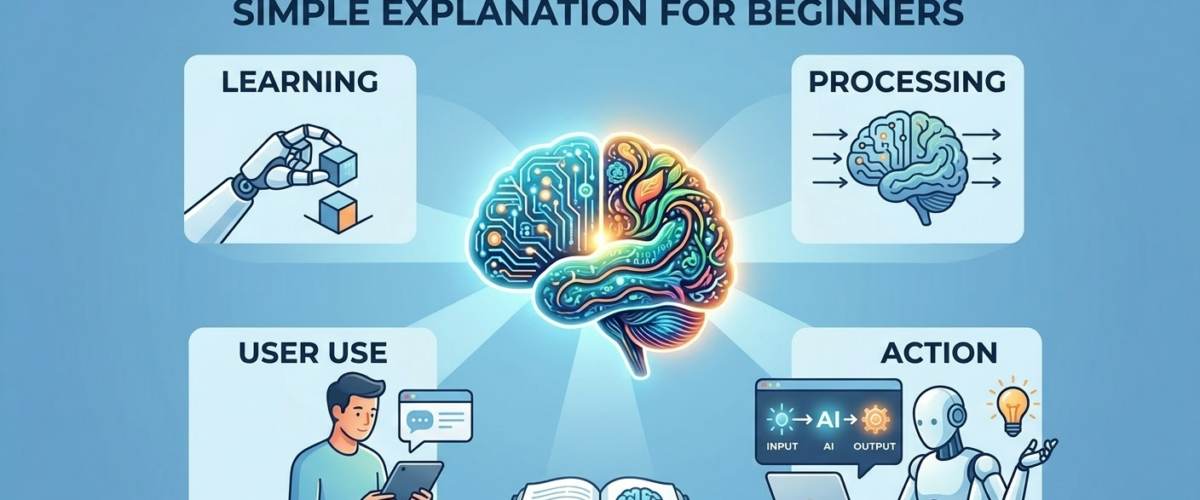
Understanding how AI learns and makes decisions is like studying a step-by-step recipe. An AI system isn’t given explicit rules for every scenario; instead, it is trained on data and examples. For instance, to teach an AI to recognize cats, engineers show it thousands of photos labelled “cat” or “not cat,” and the AI figures out the patterns that distinguish them. Over time and with more examples, the AI’s accuracy improves, much like a student getting better with each practice session.
Learning from Data
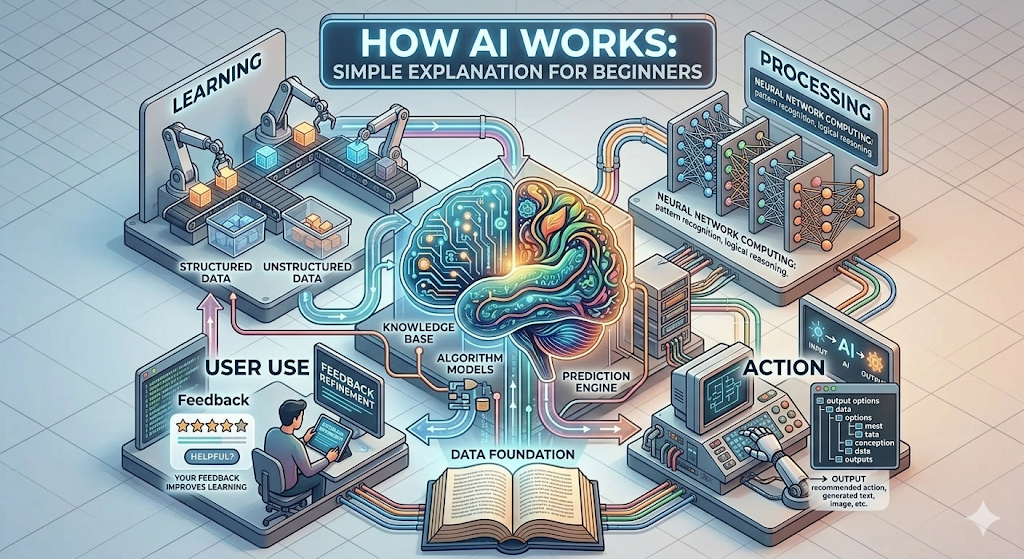
At the heart of AI is machine learning: the process by which computers learn from data. Rather than following fixed instructions, AI systems learn from experience. As App State University puts it, “AI learns by studying examples (data) to recognize patterns, much like how people learn by exploring concepts, practicing and observing the world around them.”. In other words, an AI looks at a lot of data and finds the hidden rules. For example, a self-driving car’s AI might be fed years of driving data (like camera images and sensor readings) to learn how to navigate roads and avoid obstacles.
- Data as Input: AI starts with a large dataset (images, text, or other signals). More high-quality data typically leads to better learning.
- Pattern Recognition: The AI applies algorithms to identify patterns. CSU Global explains that AI systems “identify patterns and make decisions based on large volumes of data”.
- Iterative Learning: The AI continuously refines its understanding. Each pass through the data lets it adjust and reduce mistakes, improving performance over time.
Machine Learning Steps
A practical machine learning workflow generally includes:
- Collect and Prepare Data: Gather and clean examples (like images, text, or measurements). The data must be labelled or structured so the AI can learn from it. For example, each cat photo must be tagged “cat” or “not cat.” The more relevant data you have, the better the AI can learn.
- Train the Model: Use algorithms (often neural networks) to process the data. The model makes predictions and adjusts its internal parameters to minimize errors. During training, the AI “learns” which patterns correspond to which outcomes.
- Validate the Model: Test the trained model on new data it hasn’t seen. Check its accuracy and tweak parameters if needed. This helps ensure the AI generalizes correctly and doesn’t just memorize the training examples.
- Predict or Act (Inference): Deploy the trained model to make predictions or decisions on real-world data. For example, the cat-recognition AI can now look at new pictures and say “cat” or “not cat.”
With each iteration, the AI model “practices” on more examples, just like a student refining their skills with each homework assignment.
Algorithms and Neural Networks
The core of how AI learns lies in algorithms and neural networks. An algorithm in AI is a set of mathematical rules that tells the computer how to adjust itself during training. Many modern AI models use neural networks, which are designed to mimic the brain’s structure. Atlassian describes a neural network as “like a team of tiny brains inside a computer” that work together to solve problems.
- Neurons and Layers: Neural networks have layers of nodes (neurons). Each neuron processes part of the data and passes its output to the next layer. Early layers might detect simple features (like edges in an image), while deeper layers detect complex features (like faces or objects).
- Training the Network: During training, the network adjusts the connections (weights) between neurons to improve accuracy. This involves techniques like backpropagation, where errors are sent backward to tweak each connection.
- Prediction: After training, the neural network uses the learned weights to make predictions on new data. For example, it can analyze a new photo and determine if it’s a cat by matching it against the patterns it has learned.
Neural networks allow AI to recognize complex patterns. As CSU Global notes, this lets machines make decisions without step-by-step human instructions – essentially, the network generalizes from its training to handle new situations.
Putting It All Together
In summary, AI works by turning data into insights through learning. An AI model is trained on large datasets, extracts patterns using algorithms (often neural networks), and then uses those patterns to make predictions or decisions. As CSU Global explains, AI systems “learn from experience, identify patterns, and make decisions based on large volumes of data”. Over time and with more data, the AI becomes more accurate at its task.
For example, a recommendation system (like video suggestions on YouTube) looks at your watch history (data), learns your preferences (patterns), and then predicts what you’ll want to watch next. Similarly, a language model like ChatGPT was trained on vast amounts of text so it can generate coherent replies by identifying language patterns.
Remember, AI doesn’t think like a human. It follows math and data. As App State puts it, “AI doesn’t ‘think’ like humans — it learns from data”. By giving AI the right examples and algorithms, we enable it to handle tasks – from recognizing speech to driving cars.
For more on AI basics, see our Day 1 guide “What is Artificial Intelligence? (Beginner’s Guide 2026)” to build on these concepts.
Frequently Asked Questions (FAQs) About How AI Works
Artificial Intelligence (AI) works by analyzing large amounts of data and identifying patterns using algorithms and machine learning models. These models learn from examples and improve their predictions over time. AI systems can then use these learned patterns to make decisions, recognize images, understand language, or recommend content.
AI learns from data through a process called machine learning. In this process, algorithms analyze training data, detect patterns, and build models that improve with experience. The more quality data the AI receives, the better it becomes at making predictions and solving problems.
A typical AI system includes three key components:
Data – the information used to train AI models
Algorithms – mathematical rules that process the data
Models – trained systems that make predictions or decisions
These components work together to allow machines to perform intelligent tasks.
Machine learning is a branch of Artificial Intelligence that enables computers to learn from data without being explicitly programmed. Instead of following fixed instructions, machine learning models improve their performance by analyzing examples and experiences.
No. AI does not truly think like humans. It uses mathematical models and data patterns to simulate intelligent behavior. While AI can solve complex problems and automate tasks, it does not have emotions, consciousness, or human reasoning.
AI is important because it helps automate repetitive tasks, improve decision-making, analyze large datasets, and enhance productivity across industries such as healthcare, finance, and technology.