Artificial Intelligence (AI) powers many technologies around us. From voice assistants on smartphones to recommendation systems in apps, AI enables machines to perform tasks that normally require human intelligence. In plain terms, AI refers to software and systems that can learn and reason. As IBM explains, AI “enables computers to simulate human learning, comprehension, problem solving and decision making. In other words, it’s like having a virtual brain that gets smarter with experience.
For a simple analogy, imagine a super-robot librarian that has read every book in the world and remembers everything. When you ask it a question, it can guess the answer by spotting patterns across all that information. Similarly, AI systems learn from massive data, finding patterns so they can make predictions or answer questions. Just as your phone’s autocomplete predicts words as you type, AI on a larger scale predicts outcomes based on learned patterns.
AI can do many tasks once thought unique to humans. It can recognize images (like tagging friends in photos), understand spoken language (virtual assistants), and even help diagnose diseases by analyzing medical scans. Basically, if a task involves thinking or learning from examples, AI might eventually do it.
How AI Works (Basics)
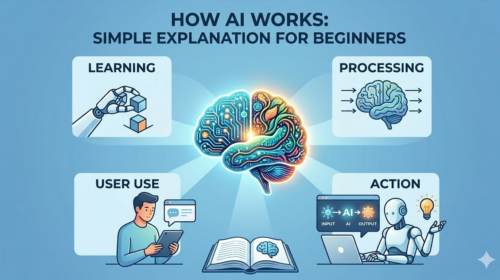
At its core, AI learns from examples. Think of it like learning to ride a bike. You start unsure, but with practice you improve. AI algorithms work the same way:
- Collect Data: AI needs large datasets (like photos, text, or recordings) to learn from. More examples make AI smarter.
- Train a Model: Using algorithms (often neural networks), the AI looks for patterns in the data. During training, the model adjusts itself to reduce errors.
- Improve Over Time: Each time the AI processes more data, it “learns” and gets better at the task.
- Make Predictions or Decisions: Once trained, AI can analyze new data and make inferences. For example, it can identify objects in a photo, answer questions, or recommend songs.
This process is called machine learning. It’s a bit like how we learn new skills through practice. As Atlassian notes, AI “learns and becomes more intelligent” from data, without needing each step explicitly programmed. Some AI uses deep neural networks (many-layered math models) to mimic the human brain’s pattern recognition. The more data and practice these models have, the smarter AI becomes at tasks like translation or playing games.
Types of AI
Today’s AI is mostly what experts call Narrow AI (or Weak AI). That means each AI system is trained for a specific task. For example, Siri or Alexa focus on voice commands, a chess engine only plays chess, and a recommendation algorithm only suggests products. Even advanced chatbots like ChatGPT, Claude and Gemini are considered Narrow AI because they specialize in text generation.
- Narrow AI (ANI): Performs one task well (e.g., image recognition, voice assistants, recommendation systems). It cannot do anything outside its training.
- General AI (AGI): A theoretical AI that would understand and learn any intellectual task a human can. This does not exist yet; it’s a future goal.
- Super AI (ASI): An even more advanced, hypothetical AI that surpasses human intelligence. This is purely speculative.
Right now, every AI you encounter is narrow. As IBM points out, “Narrow AI… is the only type of AI that exists today”. Any form of human-like intelligence (AGI) or superhuman AI remains a topic for researchers and science fiction.
A Brief History of AI
The idea of AI has deep roots, but the field officially began in the mid-20th century. In 1956, computer scientists like John McCarthy held the first AI workshop at Dartmouth College and actually coined the term “Artificial Intelligence”. They aimed to explore how machines could simulate aspects of human intelligence. Early progress was slow, but key milestones include:
- 1956 – Dartmouth Workshop: The term “Artificial Intelligence” was coined by John McCarthy during a summer workshop.
- 1997 – Deep Blue: An IBM chess computer beat world champion Garry Kasparov, showing a machine could master a complex game.
- 2010s – Deep Learning: New neural network techniques enabled breakthroughs in image and speech recognition.
- 2020s – Generative AI: Models like GPT-4 can write essays and create images from text prompts, pushing AI into new creative areas.
Each step involved better algorithms and more data. Today’s AI owes much to advances in computing power and the internet’s data sources. As AI has grown, tools have shifted from simple rule-based programs to systems that learn from data, making the field dynamic and rapidly evolving.
AI in Everyday Life
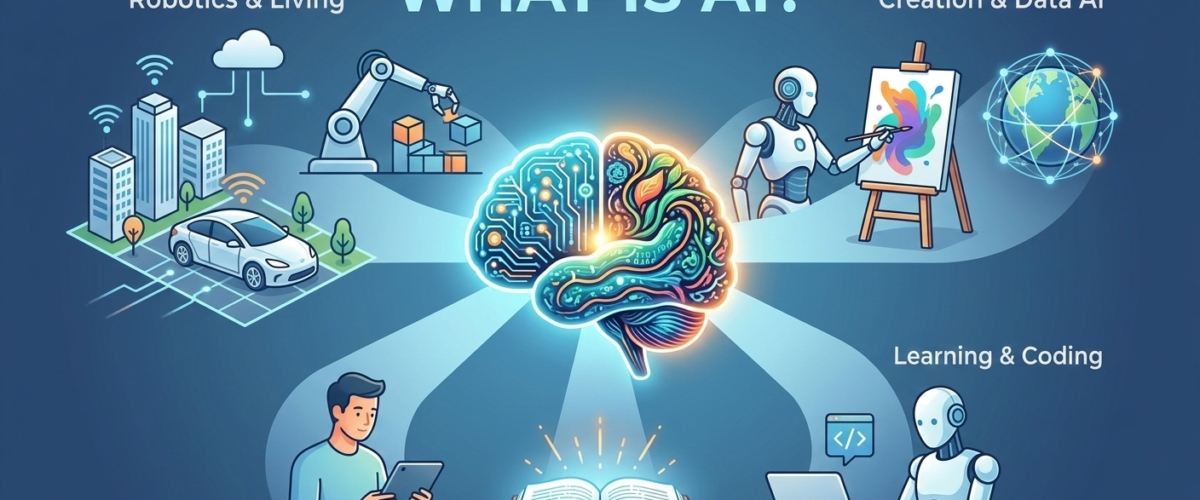
AI isn’t just theory – you encounter it daily. Here are common examples:
- Voice Assistants: Siri, Alexa and Google Assistant use AI to understand questions and respond (speech recognition).
- Image Recognition: Apps can tag faces, sort photos, or detect objects. For instance, AI can diagnose illnesses from medical images.
- Recommendations: Netflix, YouTube, and Spotify suggest movies, videos and songs you might like based on your history. These engines use AI to predict your preferences.
- Navigation: Apps like Google Maps analyze traffic patterns with AI to find the fastest route.
- Chatbots and Language Tools: Customer-service bots and translation apps (like Google Translate) use AI to answer questions or convert text between languages.
- Gaming and Robotics: AI powers video game opponents and robot vacuums. In some games (like chess or Go), AIs have even beaten human champions.
As one source notes, AI can “see and identify objects” (computer vision) and “understand and respond to human language,” even making recommendations and acting independently (like self-driving cars). In short, AI is the technology behind many features we take for granted on our devices.
Why AI Matters for Students
AI is rapidly transforming our world, so learning about it now gives students a head start. Education experts say AI is becoming “as important as reading and math,” and understanding it early provides students with a big advantage. Knowledge of AI helps young people:
- Build Critical Thinking: Using AI tools often means solving problems and thinking logically about data.
- Prepare for Future Careers: As AI changes industries, many jobs will involve working with or alongside AI.
- Use Technology Responsibly: Knowing AI’s strengths and limits leads to smarter, more ethical use of tech.
AI is a tool for augmentation, not replacement. The best outcomes happen when humans guide AI. For example, a doctor might use an AI tool to analyze scans faster, but still makes the final call. Even though AI is powerful, remember it has limits. It doesn’t truly feel emotions or understand context the way humans do. Always apply human judgment and critical thinking when using AI.
For a deeper dive into how AI systems learn and make decisions, see our next post How AI Works (Simple Explanation for Beginners). Each part of this series builds on the previous one, so you’ll get a solid foundation in AI step-by-step.
Sources: Authoritative AI definitions and history; recent AI overviews;
Frequently Asked Questions (FAQs)
Artificial Intelligence (AI) is a technology that allows computers and machines to perform tasks that normally require human intelligence, such as learning, problem-solving, decision-making, and language understanding.
AI works by analysing large amounts of data and identifying patterns using algorithms and machine learning models. These models improve over time as they process more data.
The main types of AI include:
Narrow AI (Weak AI)
Artificial General Intelligence (AGI)
Artificial Super Intelligence (ASI)
Currently, most AI systems used today are Narrow AI, designed for specific tasks.
No. Machine Learning is a subset of AI.
AI is the broader concept, while machine learning focuses on algorithms that learn from data.
AI improves efficiency, automates repetitive tasks, enhances decision-making, and powers many modern technologies such as smart assistants and predictive analytics.
AI can automate repetitive tasks, but human creativity, emotions, and critical thinking are still essential in many fields.
What are some real-life examples of AI?
Common AI applications include:
- Voice assistants (Siri, Alexa)
- Recommendation systems (Netflix, YouTube)
- Self-driving cars
- Chatbots and virtual assistants
- Fraud detection systems
What are the main types of Artificial Intelligence?
The main types of AI include:
- Narrow AI (Weak AI)
- Artificial General Intelligence (AGI)
- Artificial Super Intelligence (ASI)
Currently, most AI systems used today are Narrow AI, designed for specific tasks.